TABLE OF CONTENTS
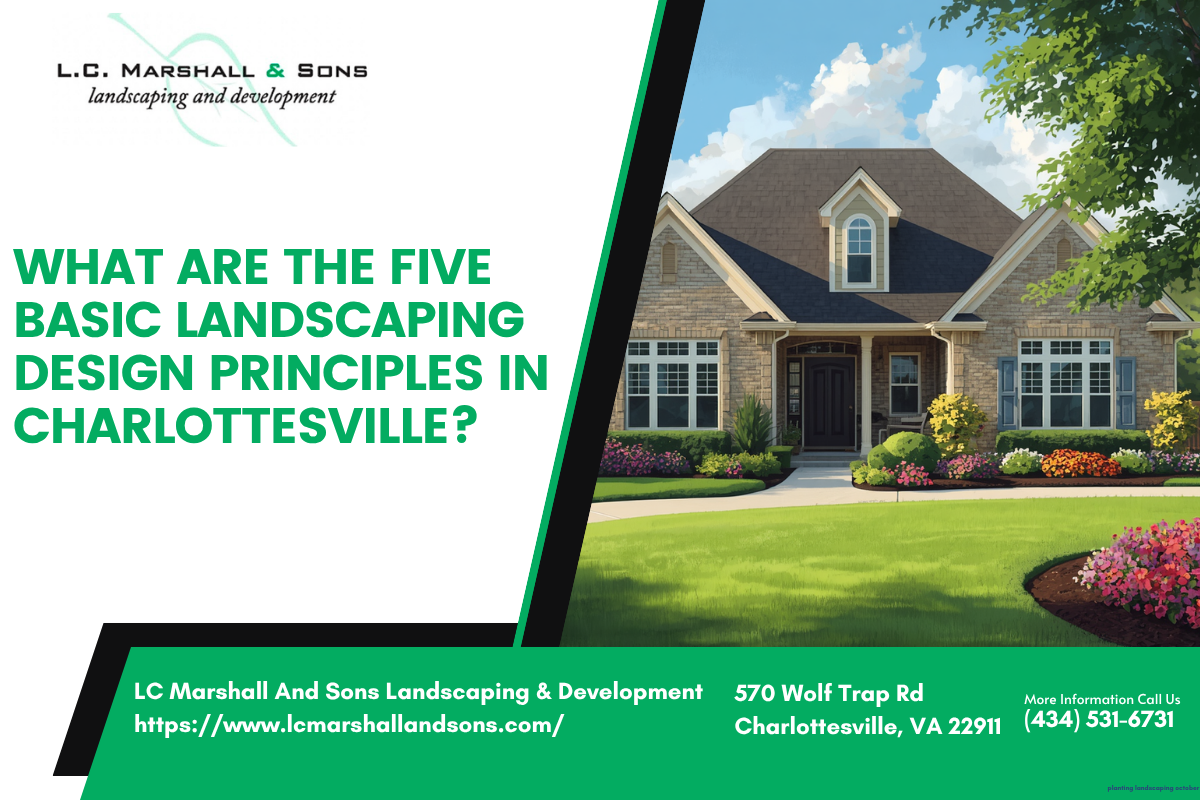
The five basic landscaping design principles used by any professional landscaping company in Charlottesville are unity, balance, rhythm, emphasis, and proportion. However, their true power is realized not as generic rules, but as a framework for creating designs that honor the region's unique Jeffersonian heritage, complement its rolling Piedmont topography, and embrace the stunning Blue Ridge mountainscape.
A Landscape That Belongs: Why Charlottesville Design is Different
Anyone can look up the foundational principles of landscape design. You'll find terms like unity, balance, and rhythm on countless websites. But here in Charlottesville and across Albemarle County, applying these concepts in a generic way often falls short. It creates a landscape that feels disconnected, like a beautiful picture in the wrong frame. Our environment is too distinct, our architectural heritage too profound, to settle for a one-size-fits-all approach.
At LC Marshall And Sons Landscaping, we've spent decades working with the unique character of this land. We believe that a successful design doesn't just look good; it feels like it belongs. It’s a direct reflection of the place it occupies. This philosophy means moving beyond simply choosing plants that survive in USDA Hardiness Zone 7a/7b and instead creating a cohesive vision that speaks the local language—a language of classic architecture, native flora, and breathtaking borrowed views.
This guide explores the five basic principles through a uniquely Charlottesville lens. We’ll show you how to transform these abstract ideas into a tangible, beautiful, and functional outdoor space that is truly your own.
Principle 1: Unity & The Jeffersonian Ideal
In landscape design, unity is the feeling that all the individual elements of your garden—the plants, the hardscaping, the structures—work together to create a single, harmonious composition. In Charlottesville, achieving unity means creating a seamless transition between your home's architecture and the surrounding landscape. Given our area's rich history, this often involves a deep appreciation for the Jeffersonian architecture influence that defines so many of our finest properties.
Homes in neighborhoods from Keswick to Farmington often feature Colonial, Neoclassical, or Federal-style architecture. The Jeffersonian ideal emphasizes order, symmetry, and a strong connection to the natural world. A successful landscape design respects this. It doesn't compete with the house; it complements it. This goes far beyond typical foundation plantings.
Achieving Jeffersonian Harmony:
- Material Echoes: The use of classic hardscaping materials like handmade Old Virginia brick for walkways or locally sourced bluestone for patios creates an immediate visual connection to the home. The goal is to make hardscaping elements feel like a natural extension of the house itself.
- Formal Structure, Natural Feel: Many historic Charlottesville properties, inspired by the gardens at Monticello or the University of Virginia, blend formal garden style near the house with more naturalistic plantings farther out. This creates a sense of order and human scale close to the living spaces, which then gently gives way to the wilder character of the Piedmont. Think of creating distinct "garden rooms" defined by low boxwood hedges or stone retaining walls.
- Cohesive Softscaping: Instead of a chaotic mix of plants, unity is achieved through a thoughtfully selected plant palette. This doesn't mean boring; it means choosing a few key plants, like the stately American Holly (Ilex opaca) or elegant Oakleaf Hydrangea (Hydrangea quercifolia), and repeating them in various forms throughout the landscape to tie everything together. This creates a sense of visual flow and sequence.
The ultimate goal of unity in a Charlottesville landscape is to create a property that feels whole and intentional, where the line between the built and natural environments is artfully blurred.
Principle 2: Balance & The Piedmont Topography
Balance is about distributing visual weight in a landscape. It provides a sense of stability and equilibrium. There are two primary types of balance, and knowing when and where to use each is critical for a design that complements the unique topography of Albemarle County.
Symmetrical Balance: The Formal Welcome
Symmetrical, or formal, balance is when one side of the landscape is a mirror image of the other. Imagine a straight brick walkway leading to a front door, flanked by identical evergreen shrubs and two matching urns. This type of balance creates a feeling of stability, order, and formality. It is most effective when used to extend the architectural lines of a classic Charlottesville home into the landscape. It’s perfect for front entryways, formal courtyards, and any area where you want to create a strong, dignified first impression and enhance curb appeal.
Asymmetrical Balance: Embracing the Rolling Hills
Asymmetrical, or informal, balance is more complex. Instead of creating a mirror image, it achieves equilibrium using different elements with similar perceived visual weight. For example, a single large specimen tree on one side of a yard might be balanced by a grouping of three smaller ornamental grasses and a large boulder on the other. This feels more natural, dynamic, and relaxed.
This approach is particularly well-suited to the rolling hills and gentle slopes that characterize our region's Piedmont topography. As landscape designers have long known, curved lines create an informal, natural, and relaxed character, which is often associated with nature. Rather than fighting the natural contours of the land with rigid, symmetrical designs, asymmetrical balance allows us to work with them. A curving garden bed that follows the slope of a hill or a meandering path made from natural pathway materials feels inherently more at home here. Proper site grading and topography analysis are the first steps to mastering this technique in your backyard design.
Principle 3: Rhythm & Repetition with Native Flora
Rhythm in landscape design refers to how the eye is led through a space. It’s created by repeating elements—like colors, textures, or forms—at intervals. This repetition creates a pattern and a sense of movement, preventing the landscape from feeling static or chaotic. In Charlottesville, the most authentic and sustainable way to create rhythm is by embracing the plants that belong here: Piedmont Virginia native plants.
Using repeating patterns of native species does more than just look beautiful; it creates a landscape that is resilient, low-maintenance, and deeply connected to the local ecosystem.
Creating a Natural Cadence:
- Plant Layering for Depth: Rhythm is often created through plant layering. Imagine a perennial border starting with a low groundcover, rising to mid-level perennials like Black-Eyed Susan (Rudbeckia hirta), backed by the taller Virginia Sweetspire (Itea virginica), and anchored by a majestic Flowering Dogwood (Cornus florida). Repeating this sequence, or variations of it, guides the eye smoothly through the garden.
- Four-Season Interest: A common mistake is designing for only one season. By using a repeating palette of native plants with varied bloom times and textures, you ensure a dynamic rhythm throughout the year. The spring blossoms of the Eastern Redbud (Cercis canadensis) give way to summer flowers, which are followed by the stunning autumn color of an Oakleaf Hydrangea and the winter structure of an American Holly.
- Sustainable and Practical: Native plants are adapted to our clay soil and climate. This means they generally require less water, fewer fertilizers, and are more resistant to local pests. Creating rhythm with natives is a core tenet of sustainable landscaping. They are also essential for creating effective pollinator gardens, supporting local wildlife, and can be key to designing deer-resistant plantings—a major consideration for any property in Albemarle County.
Principle 4: Emphasis & Borrowing the View
Emphasis is the principle of creating a focal point—a dominant element that catches the eye and serves as the centerpiece of a design or a specific "garden room." In many places, a landscape designer might create emphasis with a dramatic water feature, a piece of sculpture, or a unique specimen tree. Here in Charlottesville, we have a focal point that no man-made feature can rival: the Blue Ridge Mountains.
The most masterful Charlottesville landscapes don’t try to create an internal focal point to compete with the mountains. Instead, they practice the art of "borrowing the view." The entire design is oriented to capture, frame, and enhance the magnificent Blue Ridge Mountains views. The emphasis isn't *in* the garden; the garden becomes the frame *for* the emphasis.
Techniques for Borrowing the Blue Ridge:
- Creating Sightlines: The design process starts with a thorough site analysis to identify the best mountain views from key areas like a patio, a kitchen window, or a primary living space. Everything that follows is designed to preserve and highlight these sightlines.
- Strategic Framing: Rather than blocking a view, plants and structures are used to frame it. A pair of well-placed specimen trees can act like curtains on a stage, drawing the eye toward the distant peaks. A gracefully arching limb of an old oak can create a natural window. Even a pergola can be designed so its beams direct the gaze outward toward the horizon.
- Using Negative Space: Sometimes, the most powerful design choice is what you choose *not* to do. Leaving an open expanse of lawn or a meadow of ornamental grasses creates negative space that prevents the foreground from becoming too busy, allowing the mountains to remain the undisputed star of the show. This technique ensures the vastness of the view is felt.
Principle 5: Proportion & Human Scale
Proportion, or scale, is about the size relationship between different elements in the landscape. This includes the relationship between plants, hardscapes, the house, and, crucially, the people using the space. Getting the scale right is what makes an outdoor space feel comfortable and intentional. In Charlottesville, with the vast backdrop of the mountains, this principle takes on special significance.
A tiny patio can feel lost and insignificant against a panoramic mountain view. Conversely, an oversized hardscape can dwarf a home and feel cold and uninviting. The challenge is to balance architectural scale with human scale, creating spaces that feel both integrated with the grand landscape and comfortable for people.
Balancing Grandeur and Intimacy:
- Scaling Hardscapes Appropriately: A bluestone patio or deck needs to be large enough to be functional for dining or entertaining, but not so large that it dominates the view. Its size should be in proportion to the house. We often use retaining walls or terracing on sloped properties to break up large spaces into more intimate, human-scale "rooms."
- Plant Sizes Matter: Plant selection must consider the ultimate mature size of each plant. A tree that will grow to 80 feet tall might be perfect for framing a distant view from a large property but would completely overwhelm a smaller backyard design. We use a mix of plant sizes—from tall specimen trees to mid-size evergreen shrubs for privacy to low groundcovers—to create a sense of depth and appropriate scale.
- Creating "Ceilings" and "Walls": To make a large, open space feel more intimate, we can create a sense of enclosure. A pergola can act as a "ceiling" for an outdoor dining area, making it feel cozier. A line of thoughtfully placed evergreen shrubs or a decorative fence can serve as a "wall," defining a space and making it feel more like a comfortable room, even with the mountains visible just beyond.
Principles vs. Elements: A Quick Clarification
It's common for homeowners to ask, "What are the five key elements of landscape design?" while thinking of principles. It's a subtle but important distinction. The five principles we've discussed (Unity, Balance, Rhythm, Emphasis, Proportion) are the guiding concepts—the "what you want to achieve." The elements are the tangible tools you use to get there—the "how you do it."
The primary elements are:
- Line: The way edges of paths, beds, and structures guide the eye.
- Form: The three-dimensional shape of plants and objects (e.g., weeping, columnar, rounded).
- Texture: The surface quality of plants and materials (e.g., coarse, fine, glossy, rough).
- Color: The use of color theory in gardens to evoke mood, create harmony, or provide contrast.
- Scale: The size relationships, which is so important it's also considered a core principle.
Many of these concepts overlap with what are often called the 7 principles of architecture: balance, rhythm, emphasis, proportion and scale, movement, contrast, and unity. This highlights how intertwined a home and its landscape truly are; a successful design uses the same foundational concepts to create a cohesive experience from the inside out.
A Charlottesville Approach vs. Generic Design
Understanding these principles is one thing; applying them with local expertise is another. Here’s a comparison of how these ideas play out in practice.
Generic Landscaping Principles
Pros: Provides a basic, universal framework for design that can prevent common mistakes. It's a good starting point for any project.
Cons: Can lead to "cookie-cutter" designs that feel disconnected from their surroundings. It often ignores local climate, soil conditions (like our heavy clay soil), architecture, and cultural context. The resulting landscape may look nice but lacks a sense of place.
Charlottesville-Specific Application
Pros: Creates a landscape that is perfectly suited to the local environment. It utilizes Piedmont Virginia native plants that thrive with less intervention, incorporates drainage solutions for our region's rainfall patterns, and respects the natural topography.
Cons: Requires deep local knowledge of horticulture and ecology. Without a professional landscape architect or an experienced designer, it can be challenging to source the right materials and plants from local nurseries and garden centers.
Jeffersonian & Blue Ridge Aesthetics
Pros: This is the highest level of design, creating a landscape that is not just functional but also emotionally resonant and culturally significant. It ties the property to the historical and natural identity of Charlottesville. A study on place attachment, including an award-winning research project from the University of Virginia in Charlottesville, has explored this link between healthy longevity and our connection to a place.
Cons: This approach requires a true partnership between the homeowner and a designer who is fluent in both historical design concepts and modern sustainable practices. It is a more considered and often more involved process than a standard landscape installation.
Key Factors for Choosing Your Landscape Partner
When you're ready to create a landscape that truly reflects the best of Charlottesville, it's vital to work with a team that understands the nuances we've discussed. Here are the key factors to consider:
Understanding of local Charlottesville environment
Your designer must have hands-on experience with Albemarle County's specific challenges and opportunities. This includes deep knowledge of clay soil amendments, effective mulching techniques, sun exposure analysis on varied topography, and strategies for invasive plant removal. They should be familiar with resources like the Virginia Cooperative Extension and the work of the Piedmont Master Gardeners.
Ability to integrate Jeffersonian architectural heritage
A deep respect for local history is non-negotiable. The right partner can look at your home and see how to extend its character into the landscape, using period-appropriate materials and formal design concepts that feel authentic, not artificial. This creates a powerful sense of place, which researchers have found is key to well-being; a study on human longevity found that a strong connection to a cultural landscape can foster increased mental and physical health.
Use of native plants that thrive in the Blue Ridge foothills
Your partner should be an advocate for Piedmont Virginia native plants, not just for their beauty but for their role in creating a sustainable, resilient, and life-supporting landscape. They should be able to design stunning four-season interest using plants that naturally belong here, reducing the need for extensive irrigation systems and chemical inputs while promoting soil health.
Creation of sustainable, site-specific designs
Every property is unique. The best designs begin not with a preconceived idea, but with a thorough site analysis. The final landscape master plan should feel as if it could only exist on your specific piece of land. It should integrate elements like rain gardens to manage stormwater, promote water conservation, and look beautiful with minimal effort for years to come.
Making the Right Choice for Your Needs
The "best" landscape design is the one that perfectly aligns with your property, your lifestyle, and your vision. Here’s how these principles can be tailored to different homeowner goals in the Charlottesville area.
For "The Historic Preservationist"
Your Needs: A landscape design that respects and complements the property's historic, possibly Jeffersonian, character using period-appropriate concepts and materials.
Our Advice: Focus on the principles of Unity and symmetrical Balance. Your primary goal is to create a seamless link between your home and garden. Prioritize hardscaping materials like aged brick and bluestone. A design incorporating formal "garden rooms" with boxwood hedges, classic perennial borders, and a strong central axis will honor the property's heritage. The plant palette should feel classic and restrained, leaning on stalwarts like American Holly, magnolias, and heritage roses.
For "The Mountain Ecologist"
Your Needs: A sustainable, low-maintenance landscape that uses native Blue Ridge plants, supports local wildlife, and feels like a natural extension of the surrounding mountainscape.
Our Advice: Your design should be guided by Rhythm and asymmetrical Balance. Embrace the natural contours of your land. Use repeating drifts of native ornamental grasses, Black-Eyed Susans, and Virginia Sweetspire to create a soft, naturalistic flow. Incorporate a pollinator garden or a rain garden. Your design should feel less "designed" and more "discovered," blending perfectly into the wilder landscape of the Blue Ridge foothills and requiring minimal intervention once established.
For "The Modern Entertainer"
Your Needs: A functional and beautiful outdoor living space (e.g., pool, outdoor kitchen, fire pit) that is thoughtfully designed to blend modern amenities with the unique natural beauty and character of Charlottesville.
Our Advice: Your focus will be on Proportion and Emphasis. The key is to scale your outdoor living areas—your outdoor fire pits, patios, and pergolas—so they feel both grand enough for entertaining and intimate enough for family use. Use the principle of "borrowing the view" to make the Blue Ridge Mountains the main focal point from your entertaining spaces. Clean lines and modern hardscaping can be softened with lush, layered plantings to ensure the design feels connected to its natural setting, not imposed upon it.
Ultimately, a successful Charlottesville landscape is a conversation between history, nature, and your own personal vision. The five core principles of design are your vocabulary, but the story you tell is unique. At LC Marshall And Sons Landscaping, we specialize in helping homeowners find their voice and translate it into a beautiful, functional, and enduring outdoor space. For a personalized assessment of your property and to discuss how these principles can be brought to life for you, contact our expert team today.

Featured Posts