TABLE OF CONTENTS
The most common lawn care mistakes in Waynesboro are not just tactical errors like improper mowing or watering. The most critical failure is strategic: ignoring how the Shenandoah Valley's fluctuating groundwater table dictates soil moisture from below, leading to compacted soil, suffocated roots, and persistent lawn problems.
The Frustrating Cycle of Common Lawn Care Mistakes
As a landscaping professional with decades of experience here in the Shenandoah Valley, I've seen countless homeowners in Waynesboro and Staunton invest time, money, and sweat into their lawns, only to be met with frustrating results. They follow the conventional wisdom, buy the popular products from brands like Scotts, and yet their turf struggles with bare patches, persistent weeds, and recurring disease. Why? Because most advice ignores the ground beneath our feet.
Before we dive into the one major strategic error, it's important to acknowledge the common mistakes that compound the problem. These tactical slip-ups weaken your lawn, making it more vulnerable to the deeper issues we'll discuss. Think of these as adding stress to an already stressed system.
1. Improper Mowing Habits
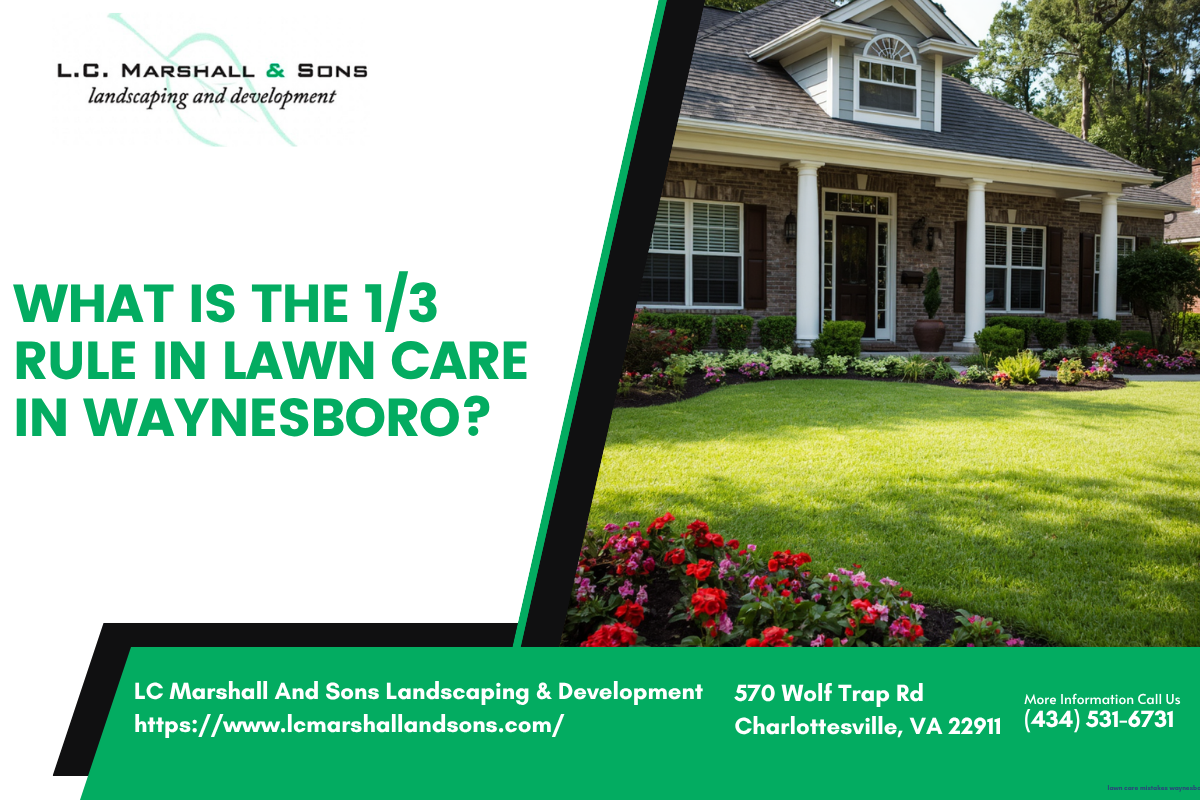
Mowing seems simple, but how you do it has a profound impact on grass root development. The most frequent error is cutting the grass too short, often called scalping the lawn. This violates the single most important mowing guideline: the one-third mowing rule. This rule dictates that you should never remove more than one-third of the grass blade's height in a single mowing. When you cut more, you shock the plant, reduce its ability to photosynthesize, and encourage shallow root growth, making it susceptible to drought stress. Using dull mower blades is another culprit; they tear the grass blades instead of slicing them cleanly, creating ragged wounds that invite lawn diseases.
2. Misguided Watering and Fertilizing
Watering at the wrong time, typically between 10:00am and 4:00pm, leads to significant evaporation and can encourage fungal growth. Similarly, frequent, shallow watering encourages roots to stay near the surface, searching for that next quick drink, rather than growing deep. On the fertilizer front, many homeowners engage in uneven fertilizer application or use the wrong fertilizer type without performing a soil test first. Without understanding your soil PH and nutrient deficiency, you're just guessing, which can do more harm than good and lead to thatch buildup.
The Real Culprit: A Strategic Failure to Understand Our Unique Environment
Here is the core thesis: The most damaging lawn care mistakes made in Augusta County are not about mowing frequency or fertilizer application timing. They stem from a fundamental misunderstanding of our region's unique hydrogeology. We live in a Transition Zone Climate, but more importantly, our lawns are profoundly influenced by the Shenandoah Valley's dynamic groundwater system.
A lawn care strategy that works in a different part of the country will often fail here because it doesn't account for the seasonal rise and fall of the water table. This single factor changes everything about how you should approach watering, aeration, and even disease management.
Why the "One Inch of Water Per Week" Rule Fails Here
You've heard the advice everywhere: "Give your lawn 1 inch of water per week." While well-intentioned, this generic guidance is dangerously simplistic for our area. It completely ignores the moisture already present deep in the soil profile, supplied by groundwater. In fact, a healthy grass plant's weight is composed of 75 to 85 percent water, which is essential for its most basic functions according to the Virginia Cooperative Extension. The question isn't just how much water you add to the top, but how much is already coming up from below.
The water table—the level below which the ground is saturated with water—is not a fixed line. As the USGS notes, the depth of the water table is not static; it can rise or fall depending on the time of year, with increases in late winter and spring from snowmelt and rainfall according to the U.S. Geological Survey. In our region, after a wet winter and spring, the water table can be surprisingly high. Applying an arbitrary "one inch" of water to a lawn whose root zone is already saturated from below is a recipe for disaster. This leads to overwatering, which is far more damaging than underwatering.
The Hidden Link: Water Table, Compaction, and Root Suffocation
When the water table is high, the pore spaces in the soil that should hold oxygen are instead filled with water. Your grass roots need oxygen to survive and absorb nutrients. Without it, they literally begin to suffocate. This chronic, low-oxygen environment is the real root cause of many common lawn problems:
- Soil Compaction: Persistently saturated clay soil, common in our area, becomes compacted easily. Waterlogged particles press together, squeezing out any remaining air pockets and creating a dense, impenetrable layer.
- Shallow Roots: Why would roots grow deep in search of water when they are drowning in it just a few inches below the surface? A high water table discourages deep root growth, creating a weak, dependent turf.
- Disease Proliferation: Fungi like Brown Patch Fungus and Dollar Spot thrive in damp, low-oxygen conditions. Many homeowners see the fungus and reach for a fungicide treatment, but they're only treating a symptom. The underlying cause is the saturated soil created by a high water table.
You can perform every surface-level task perfectly—mowing, fertilizing, weed control—but if you have an unaddressed subsurface water issue, your lawn will never achieve its potential. The turf will continually struggle with turfgrass stress, unable to withstand the heat of summer or a period of drought.
How to Make Smarter, Hyper-Local Decisions with Public Data
Instead of guessing, you can use publicly available scientific data to inform your lawn care. The USGS maintains a network of wells to monitor groundwater levels across the country. You can access this data to get a real-time understanding of what's happening beneath your property. By checking the data for a monitoring well in or near Augusta County, you can see if the water table is trending higher or lower than average for that time of year.
This information is powerful. For example, if you see that groundwater levels are unusually high after a wet spring, you know to:
- Delay or Reduce Watering: Let the soil profile dry out. Your lawn's roots may have all the water they need just below the surface.
- Prioritize Core Aeration: This is the single best practice to combat soil compaction. Aeration pulls plugs of soil out of the lawn, creating channels for oxygen to penetrate the root zone and for excess water to evaporate.
- Re-evaluate Drainage: If certain areas of your lawn are chronically wet, it may be a sign of poor soil drainage issues that need to be addressed with a more permanent landscaping solution.
Moving beyond treating symptoms like weeds or brown spots to addressing the root cause—a lawn care strategy not adapted to our region's hydrogeology—is the key to long-term success.
Answering Your Common Lawn Care Questions
Let's address some of the specific questions we often hear from homeowners trying to diagnose their lawn problems.
What are the most common lawn care mistakes to avoid?
The most common tactical mistakes are mowing too short, using dull blades, watering at midday, over-fertilizing without a soil test, and ignoring soil compaction. However, the most critical strategic mistake, especially in the Shenandoah Valley, is failing to adapt your lawn care plan to the reality of our fluctuating groundwater levels.
What is the 1/3 rule for lawn care?
The one-third mowing rule is a foundational principle of proper lawn care. It states that you should never remove more than one-third of the total height of the grass blades in a single mowing. For cool-season grasses like Tall Fescue, if you want to maintain a height of 3 inches, you should mow it when it reaches 4.5 inches. Following this rule promotes deep root growth and overall plant health.
Wait, what is the 150 rule for lawns?
While you may have heard of a "150 rule," it is not a standard or widely recognized term in professional turfgrass management. Some may use it to refer to growing degree days for timing certain applications, but it's often a point of confusion. For homeowners, focusing on the universally accepted one-third mowing rule is far more practical and impactful for achieving a healthy lawn.
What does Dawn dish soap do for your lawn?
This is a common DIY myth with a kernel of truth. Dish soap can act as a surfactant, breaking the surface tension of water and helping it penetrate hard, dry soil temporarily. It's sometimes used to identify grub activity by forcing them to the surface. However, it is not a solution for lawn health. It can strip the natural protective waxes from grass blades and harm beneficial microorganisms in the soil. For soil that repels water, the proper long-term solution is core aeration and amending the soil with organic matter like compost, not dish soap.
Comparing Approaches: Tactical Practices vs. Strategic Understanding
To achieve a truly resilient lawn, you must understand the difference between short-term tactics and long-term strategy.
Tactical Lawn Care Practices (e.g., mowing, surface watering)
These are the day-to-day and week-to-week tasks of lawn maintenance. Their advantage is that they provide immediate visual results—a freshly cut lawn always looks tidier. However, when performed without a deeper strategy, they often just treat symptoms. For instance, repeatedly applying fungicide to a lawn with Brown Patch is a losing battle if the underlying cause is saturated soil from a high water table. These tactics can become inefficient, costly, and ultimately ineffective if the foundational environmental factors are ignored.
Strategic Environmental Factors (e.g., groundwater, water table fluctuations)
This approach involves understanding and adapting to the unique environmental conditions of your property, primarily soil composition and subsurface hydrology. The benefit is profound: it addresses the root cause of problems, leading to a healthier, more resilient, and less dependent lawn in the long run. The initial effort might be greater—it requires learning about your local conditions or investing in services like core aeration or drainage correction—but the long-term payoff is a lawn that thrives naturally rather than one kept on life support.
Key Factors for a Thriving Waynesboro Lawn
When choosing a lawn care plan or a professional service, focus on these critical decision factors.
Understanding of local soil and groundwater conditions
Does your approach or your provider have a deep, specific knowledge of Shenandoah Valley soil types (like our heavy clay) and the impact of our groundwater? A generic, one-size-fits-all plan is destined to underperform here.
Long-term root health vs. short-term surface appearance
The goal should always be to cultivate a deep, robust root system. This is the engine of a healthy lawn. Be wary of treatments that promise a quick green-up but do nothing to address underlying issues like soil compaction or poor drainage, which inhibit root growth.
Services addressing drainage and subsurface moisture
A truly comprehensive lawn care service doesn't just work on the surface. It should have the expertise and equipment to diagnose and remedy subsurface problems, offering services like professional core aeration, dethatching, and even landscape drainage solutions when necessary.
Making the Right Choice for Your Needs
There is no single "best" path for every homeowner. The right strategy depends on your goals, your property's specific challenges, and your willingness to engage with the process.
For The Frustrated DIYer
You're doing everything by the book—mowing high, watering deeply, fertilizing on schedule—but your lawn still looks stressed. Your next step is to look down. The issue is likely not in what you're doing, but in the conditions you're doing it in. Start by familiarizing yourself with the USGS groundwater data. Correlate your lawn's worst periods with times of high groundwater. Your focus should shift from more surface treatments to fixing the subsurface: prioritize a deep core aeration this fall to break up compaction and improve oxygen flow to the roots.
For The New Shenandoah Valley Resident
Welcome to the area! If you've moved from a region with sandy soil or a different climate, be prepared to learn a new set of rules. The heavy clay soil and influential water table here behave differently. Your first step should be a professional soil test through an organization like the Virginia Cooperative Extension to understand your baseline. Avoid simply replicating the lawn care routine that worked at your old home. Instead, prioritize learning about the unique challenges of a Transition Zone Climate and the specific needs of cool-season grasses like Tall Fescue and Kentucky Bluegrass in our environment.
For The Eco-Conscious Homeowner
You want a beautiful lawn without wasting water or overusing chemicals. A strategy based on understanding the water table is perfectly aligned with your goals. By working *with* the natural water cycle, you can significantly reduce supplemental irrigation. When the water table is high, you water less, conserving a critical resource. By focusing on soil health through aeration and topdressing with compost, you build a resilient lawn that is less susceptible to pests and diseases, reducing the need for chemical interventions. You might also consider incorporating sections of native Virginia plants in your landscaping, as they are beautifully adapted to our local climate and require far less maintenance as noted by experts.
Ultimately, achieving a healthy, resilient lawn in our unique environment requires a shift in perspective. It means moving beyond a simple checklist of tasks and developing a deeper, strategic understanding of the land itself. It's about working with the powerful natural forces that shape our landscape, not against them.
For homeowners in Waynesboro, VA, and the surrounding Shenandoah Valley communities who want to move beyond the frustrating cycle of treating symptoms, LC Marshall And Sons Landscaping offers a strategic, science-based approach. We combine decades of local, hands-on experience with a deep understanding of the subsurface conditions that determine lawn health. For a comprehensive assessment of your property and a plan that addresses the true root cause of your lawn care challenges, contact our expert team today for a free consultation.

Featured Posts